STABILITY IN LIFE CAN FOOL YOU INTO THINKING NOTHING IS CHANGING WHEN REALLY, CHANGE IS CONSTANT.
***
Leaving my job last summer has been my brand for the past six months. It seems that everything I do and feel lately has somehow flowed from that. But it goes further, because there is a lot that I am doing and feeling. Even though much of it feels futile and intangible.
Though I’ve never been interested in the idea of being “multi-passionate”, I admit that that’s exactly what I am. There are many things that call my attention every day – many things I am passionate and curious about. I find myself running between working on my pottery website to wondering the last time I wrote a poem, to wanting to write more of my novel to feeling bad because I haven’t cycled in a while to deciding I want to knit a jumper, to realising it’s been a while since my last blog post. I can do all these things. But I get stuck in a cycle of paralysis when few of them have the foundations for me to ease back into their development (i.e., no ideas for a blog post idea or poetry rejections). I find it easier to hold one ball at a time while the others drop. And that’s not anything groundbreaking. Our brains can only handle so much at once.
As I chase everything and subsequently nothing all at once, an image of me running helter-skelter develops in my mind. Chasing the wind, trying to grab a balloon floating into the sky while a pot of rice burns on the cooker and music blares from my laptop while I’m on FaceTime to someone and a call from my mum is incoming. It’s all happening at the same time. And paying a shred of attention to all these things just makes me feel restless. Chasing them all is a true image of that.
But I’m reminded of a brief conversation I had with my sister a few months ago. We were in church and a four-year-old girl was running around with her little brother. So loud, energetic and happy. I asked my sister why children have so much energy, and she told me it’s because they are growing. They need energy to grow. Their bodies are hungry for all that is needed to expand them into the world.
It has stuck with me since then. And last week I thought to myself, am I restless because I am growing? It’s most convenient to tell myself that yes, that’s why. So naturally I hesitate to fully adopt this thought because isnt that too idealistic?
Yet overwhelmingly, the epiphany replays in my mind. I still don’t know where my life is headed (but who does anyway?) and I am starting to let go of what I think I must believe, do and be, and that worries me. So could this restlessness just be a symptom of my gradual expansion into something different?
Children grow and so do teenagers. Adults do too. In fact, outside of growth, we are simply developing and changing all the time. So why would it be a surprise to me that I am growing right now? I’ve always been passionate about growth but I’m realising that it was on my mind less and less when I was working. I think that’s because stability in life can fool you into thinking nothing is changing when really change is constant. Moreover when you are not stable, change suddenly feels vast, present and unapologetic.
That’s where I am at the moment. Even if I truly am growing at a faster rate today than I was a year ago, I accept that the rate is allowed to change. With that I find peace. And overall, I am happy to accept that the restlessness I feel could just be a symptom of roots growing deeper, a plant budding under the sunlight, a season changing.
DON’T SAY IT’S NOT THAT DEEP IF WE NEVER WEAR OUR HAIR OUT. I AM IN THE BUSINESS OF EVERYTHING BEING “THAT DEEP.”
***
I have so much to say about afro hair. When people discuss the topic online I feel very inspired to contribute my thoughts, so writing will help me get them all out. This post will use my personal journey to address all things afro hair – past, present and future. I’ve added pictures (non-chronologically) for reference, and affordable product recommendations at the end. If you have afro hair, this is for you. There will certainly be something in this piece that resonates.
Part 1 – My journey and formative years
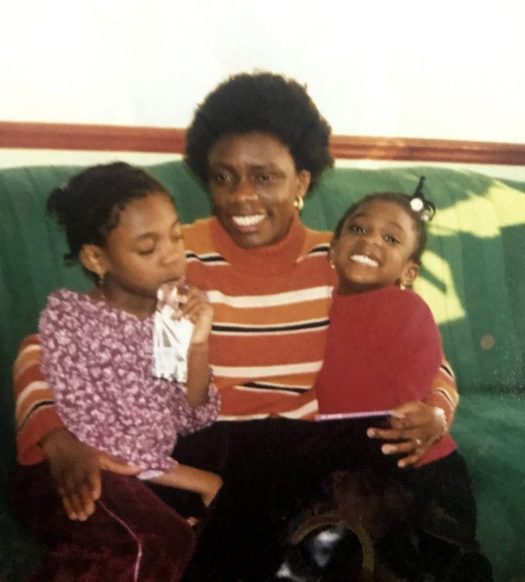
I have always enjoyed the feeling of a slight tug or fingers on my scalp as my hair is washed, though I know that puts some people off if they have a sensitive scalp. The earliest memories I have of my hair are the stereotypical ones, my mum braiding my hair after church every other Sunday right after my older sister, sometimes in traditional Nigerian styles like suku. I found it so fun and relaxing to get my hair done. (Pictured: Sister left, mum centre, me right)
This was back in primary school, and I didn’t feel out of place with these styles. The times where I did feel envious of other girls’ hair was when I saw it had been relaxed. Stiff and brown as it may have been, I did imagine to myself what it would be like to have hair that just went down instead of up. It’s only later in my life that I began appreciating the fact that afro hair defies gravity.
I remember the first time I got weave. It was in primary school too. To be honest it was quite off brand for my mum, since she always gave my sister and I plaits/cornrows. But I remember the weave being so itchy that we both had it removed the next day. After that, tracks didn’t touch my hair until year 11 prom… we’ll get to that. But generally speaking, having afro hair wasn’t a source of shame for me. I liked it. I felt like my hair was long and healthy, and as a child that was enough for me.
Secondary school
By year seven my mum grew tired of doing our hair, so she began paying a hairdresser to give us braids instead. I wasn’t mad at it. Braids felt a bit more suitable for secondary school, and hair “suiting” your age is something Black women tend to consider. But by the time I was 12 I began looking after my own hair, so secondary school is where I’d say my story truly begins. While I acknowledge that I didn’t have solely negative messaging about my hair from the day I landed on earth, the styles I had still paved way for insecurity in my teens. This is because I didn’t know what a high-tension style was, and it showed. I would tug my braids into a variety of styles that did nothing but pull on my edges. From single plaits in a tight half up half down to Ghana weave that lifted follicles at my temples, I didn’t understand that styling my braids was affecting me. I remember one nightmare moment, where I caught the front of a Ghana weave plait in a badminton net during P.E, causing it to rip at the front. Pain! And whenever I had braids I kept them in for too long and watched follicles show up along my hairline, my confidence in showing my edges dwindling. I noticed them getting thinner, especially at my temples. And I was only a teenager.
Despite that, I still had moments where embraced what I saw in the mirror. Credit is due to my immersion in the natural hair movement of the 2010s. What a time. I spent hours watching older Black women (mostly American) on YouTube explaining their hair regimen and giving advice for growing healthy and long hair. But I was a teenager with no money, so the products they recommended weren’t in my reach. The closest I got to it was buying Eco Styler gel and coconut oil. At some point, I even used baby oil because to me at the time, oil was oil right? That’s all I could manage. I learnt how to do Bantu knots and braid outs, even though my hair was not as thick and long as the women in the videos I was watching.
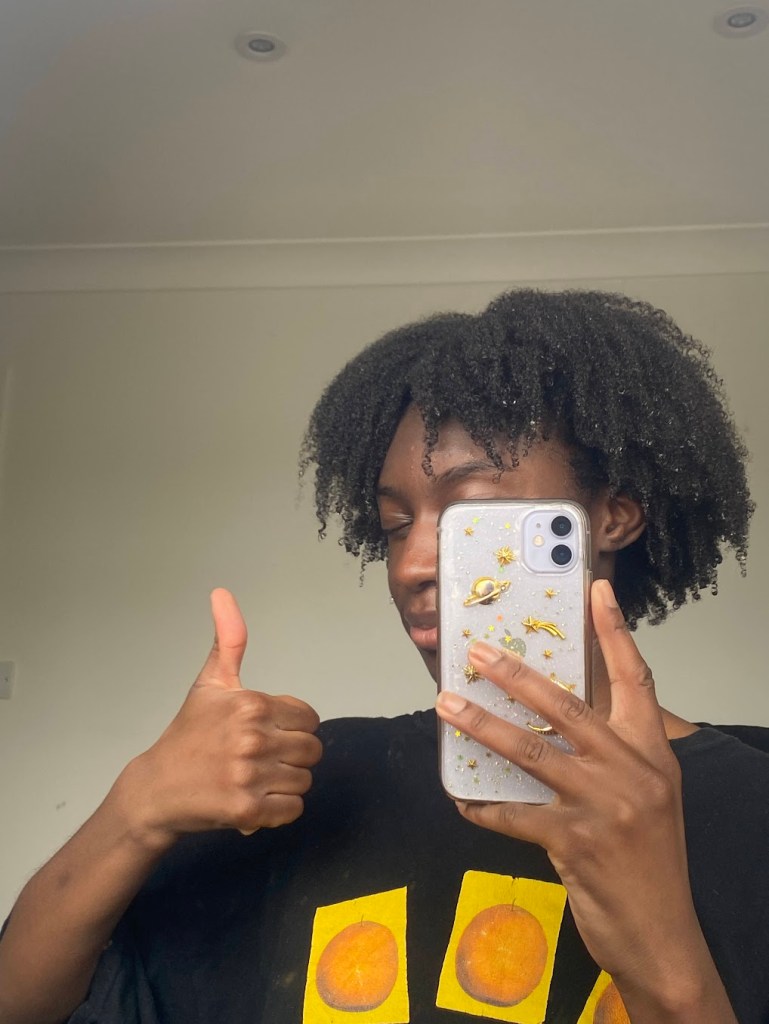
By doing this from a young age I essentially experienced exposure therapy. I took a plunge into doing my hair, accepting any outcome and going to school with it for chunks of time in between braided hairstyles. From a struggle bunch that was the size of a golf ball to the same style but with a quiff, it truly paid off. But don’t get it twisted – even though I would get compliments on how “soft” it was because people loved to touch it, I still compared myself to girls with looser textures, longer, thicker hair and access to a wider range of products. (Video from 2016)
Moreover, I was teased for it too, by different people. I remember having my hair out in an afro one day. I’d used a pick to comb it right out and gone to school. During a lesson I went to the toilet and found two white girls in there. When they saw me and my hair, they burst out laughing. It could have been a destroying moment but for some reason I took it on my chin and used the toilet without acknowledging them. In my heart I felt hurt. But it was the kind of hurt you feel as a Black person when you experience racism then ask yourself why you are even surprised. By purely existing we are exposed to prejudice and poor treatment. The girls did just what I would have expected them to do. But unfortunately, it wasn’t just them. There were two Black girls in my form class that I always chatted with. When I showed up in an afro all they could do was question why I would even dare to do that. The second time I did it, they sighed, truly irritated with me for wearing my hair that way. Looking back, I think they may have found it embarrassing since we were all Black girls. Maybe they didn’t want to be represented in that way as depending on who you were/are exposed to, wearing your afro hair out is not “cool”. And that applies to this day. You may be someone who loves their hair for what it is but many women are not in that position because of their circle. Regardless, Black women are accustomed to their hair being a problem for others across the board.
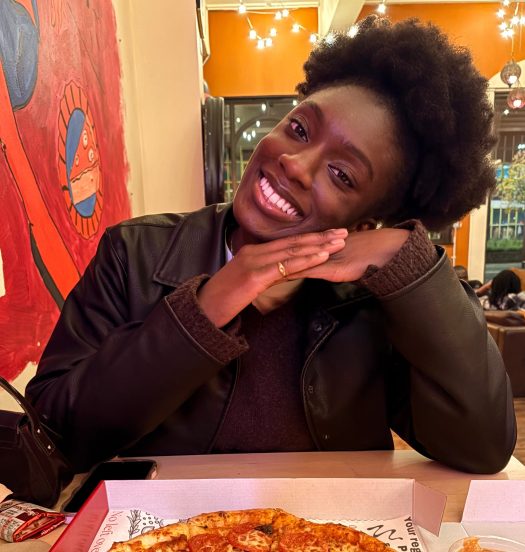
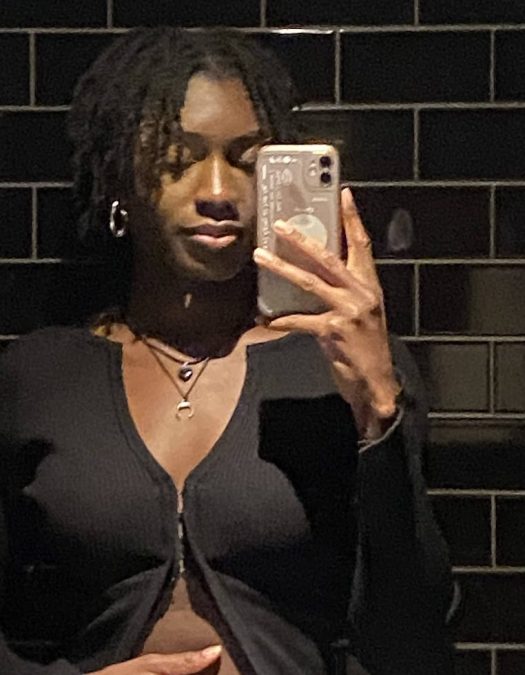
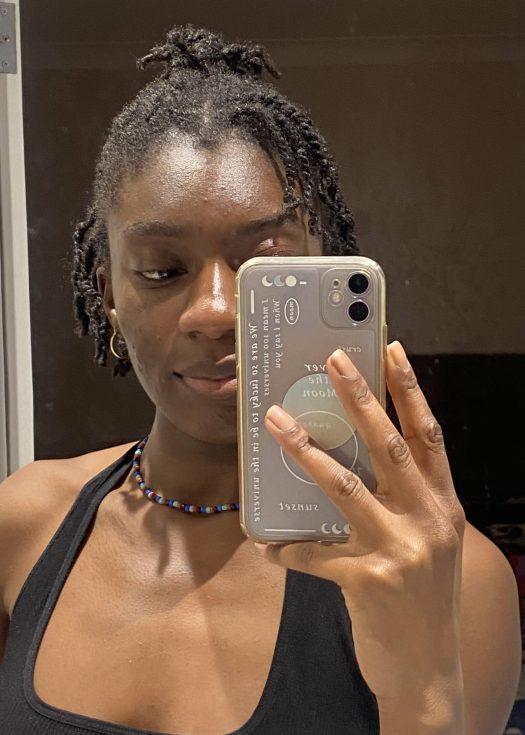
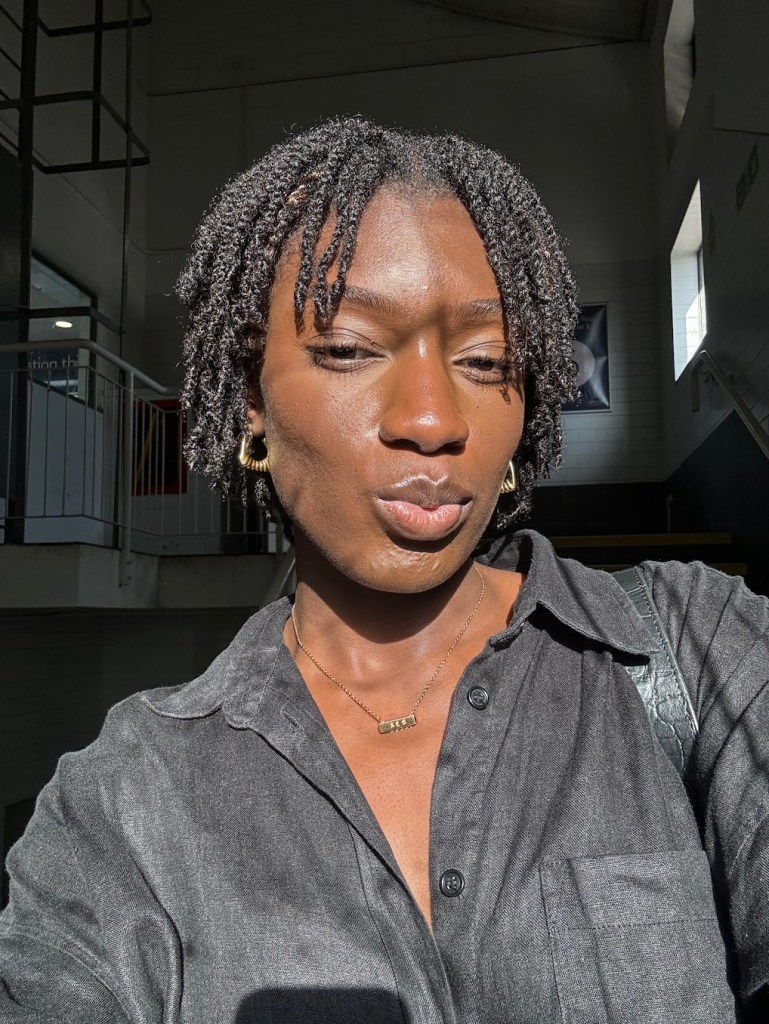
You can tell from how I write that hair has always excited me. I learned to braid when I was really young and my first career ambition was to become a hairdresser. But not everyone is passionate about hair this way. That’s why simple styles are important. I adhere to a puff. It’s my go-to to this day. I just braid or twist my hair, and the next day I take it out and pull it above my head. (Pic from Nov 2025)
Some women hate sitting in the salon chair and others do not want to lose an extra 30 minutes of sleep to do their hair in the morning, which is fine. So what I lobby for is for people with afro hair to have a style they are happy with and keep it as a staple. Due to our hair’s versatility we are too bogged down by the range of styles we can wear. We are very accustomed to being bored by the same style. But if we just chose a simple one to stick to, there would be less substitution with styles that mimic other textures, and less stress surrounding general hair styling.
Part 2 – Critique and afro hair in practice
Note: I know that there is less for me to unlearn about afro hair because I did not internalise every harmful rhetoric about it growing up. I also understand that there are a plethora of reasons why some Black women do not wear their natural hair out. I’ll get to that.
Thin edges
It’s not like we don’t have products for this very issue, but in my opinion this is the reason why we end up covering our hair a lot, and it’s not spoken about enough. High tension styling can lead to thinning and hair loss along our hairlines. Ironically I see loads of comments citing every other reason for not wearing afro hair out, but edgelessness is scarcely one of them. If we are unhappy with not having edges, we may wear styles that cover them up. But these styles are hardly ever follicle-friendly. So, the cycle continues.
Protective styling (particularly with any form of extension) is not always protective, let’s be real. Gluing a lace wig to your head and catching delicate edge hairs in the removal process can pull your edges out. Knotless braids can rip your edges out. Normal braids can rip your edges out – from the follicle (I’ve been there). Ponytails and slick back styles can pull your edges out. Tight plaits/cornrows can rip your edges out. Any type of heavy style can rip them out. You may have also experienced the horror of extreme hair loss following these styles – your hair feeling dry and thin at the ends, heat damaged and brittle. Something just doesn’t feel right after the takedown. But you know what keeps your hair and edges safe? Not touching them at all!
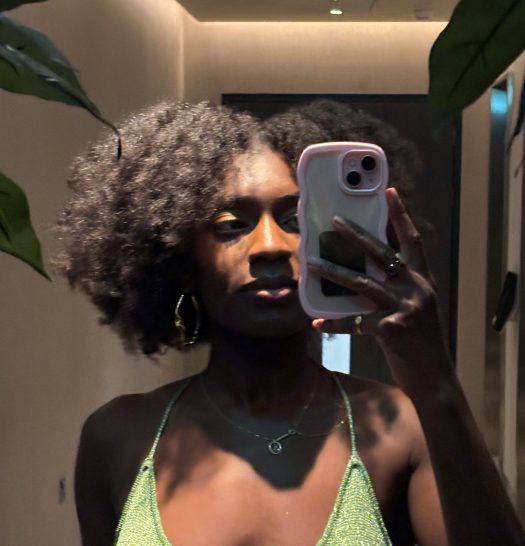
I acknowledge that is difficult when you want to lay your edges and style them in a certain way, especially for a slick look. But how necessary is it for our hair to be slick anyway? The truth is the hairline thrives the most when it is left alone, inferring that we need to leave our edges/hair in a state that does not require them to be tugged at all. (Pic from Dec 2025)
Then we can wait and see the efficacy of the products we are using to grow them back. They are redundant if we are not allowing our hair to breathe and rest. Over time we can reach a point of confidence with our edges and low-tension styling. It takes boldness to do this. How bold would you dare you be?
I can’t cover this topic without mentioning alopecia, or traction alopecia, which of course the previous paragraphs do not pertain to. Some people suffer from irreversible hair loss due to health conditions, or irreversible effects of high-tension styling. That’s not who I am addressing here. There remain treatments for some solvable cases, such as PRP injections and hair transplants to restore hair confidence. I am not against any of those solutions, in fact, specifically because it may inspire people to wear their hair out more, I would encourage it provided you can afford it. But in the meantime, it is not worth getting stuck in the catch-22 of covering or tugging at the hairline if your goal is regrowth. We must leave our hair alone and treat it with tenderness.
Straight hair
I wore straight hair for my year 11 prom. Premium Too. Synthetic, Colour 4. Leave out. Imagine the sight! Part of me was overjoyed that I could try out a style that I really wanted despite being happy with my afro. But it was a struggle – the hairdresser didn’t leave out enough hair and the texture certainly didn’t match mine. Maintaining it was therefore difficult and I didn’t wear straight hair again until second year of uni, when I tried out my first straight wig. Another error. I bought the bundles and sewed it myself – a process that I really enjoyed. But my expertise in wigs was capped in comparison to natural hair, and I felt really insecure wearing the wig. Of course you could argue that I wouldn’t have felt that way if it was styled better, and part of me would agree. But I wore the wig for less than a week, then switched back to braids.
I think seeing myself with a texture that was different from my own just didn’t make me feel confident. It was around this time that my desire to be the best version of my natural self really came to life. I didn’t want to be more confident with someone else’s texture on my head instead of my own. (Pic from Nov 2023)
There is so much conversation surrounding this. So many videos and tweets insinuating that if you perpetually wear straight hair you are anti-black or hate yourself. I think those words are insightful, though they could do with nuance for those who go on the offensive when they hear them. The primary message to platform is one of accepting your hair for what it is. Reaching a point of hair neutrality at the very least, where neither like nor dislike is prescribed to your hair, but rather an acceptance of its natural existence. Then you may accept that you can’t (and shouldn’t) change it because it grows like that as a representation of your true self. When this is acknowledged, links to anti-blackness will show themselves without being preached to from a place of critique. Firm words matter, but you can’t encourage someone to embrace their true self by starting off with “you hate yourself.” Some may hear this and understand, while others may need more of a breakdown.
How radical shall you be?
It’s a blessing and a curse that Black women are afforded so many styles to try out. So many textures, designs, inspirations, techniques, the list goes on and it’s so admirable. But sometimes the wealth of hair options turns into analysis paralysis. The desire for a new hairstyle to uplift oneself and feel brand new directly ties to how Black women are expected to show up in society, and it is a representation of how our worth has been tied to the way we look.
Here, the intersection of Black femininity must be acknowledged – allusions of womanism rather than feminism. The standard is higher for Black women, and the pressure to be presentable, as enforced on us from everyone including the women closest to us and the men we may (seek to) date (a heteronormative perspective of course) leaves us continuously conscious of how we look (encompassing hair) and how we can keep the world engaged as we move through it, even if we do it silently.
I therefore believe true freedom for afro hair occurs when a Black women no longer feel the need to “switch it up.” Yes, it’s nice to see yourself in a new look and feel renewed, but how many renewals must we undergo? Do we see that the return to renewal is an indication of its fleeting nature? What can we tie ourselves to that will actually last longer than a new hairstyle and leave our follicles in our scalps? Perhaps, the natural self. (Video from July 2024)
Rather than deciding what style to do next because I want something new, I challenge myself and anyone reading his to try and keep the same simple style for a while and see from where beneath the surface you can draw renewal. This isn’t to say that I will never switch it up and wear my hair in a new style again. It’s instead a radical decision to look within myself for the joy that changing my hair brings me. That can come first and hair can come second.
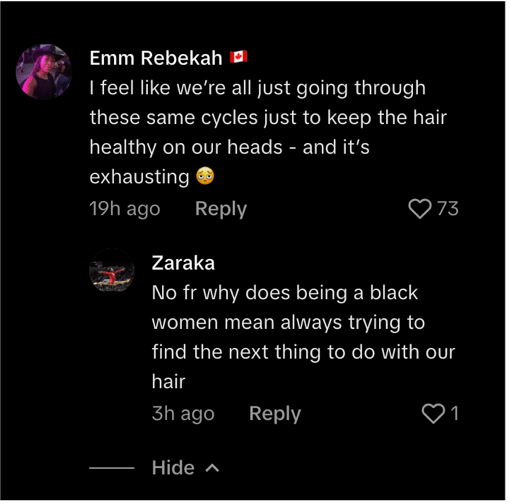
While deciding what style to choose next we may end up feeling so low. We even talk about how we aren’t depressed; we just need to get our hair done! Well, what does that say about our wider state of being? I am tired of hair math and calculating backwards from my birthday what I may do with my hair. In reference to this TikTok screenshot, how about we just let our hair be, in its natural state?
This is a form of resistance for Black women. We must accept that there is no social benefit of wearing our hair more than anything else. We won’t get “further” because of it – we may actually get further with a straight wig. So how radical do you want to be? Would you like to wear your hair out anyway? Would you like to be the sole benefactor of your own liberation, or would you rather coast through life beneath a texture that doesn’t belong to you? Would you like your confidence to be tied to your true self? To embrace your natural hair is to chose the path of resistance and refuse to meet society’s standard of how a Black woman should be received. I think we need to be more radical about this than we have been in recent years.
Time
You may have read the above and clocked out thinking, sorry I don’t have the time. But that’s where my thoughts get more radical. Considering how life moves and changes, we can’t always allocate the same amount of time to everything. For many, hair is included in this. In 2020 I read “Don’t Touch My Hair“ by Emma Dabiri, which opened my eyes to the provenance of Black hairstyling and inspired me to write an article about the relationship between Black hair and time. I rephrased my approach to it all by insisting that rather than my hair taking “too much time” to do, I give my hair the time that it requires. In its natural state, afro hair can require a bit more attention and patience than raking a comb through it and going about your day. Yet, it is still worth learning to love and care for, to maintain its health and integrity. In its native setting, hair care was creative, communal and ritualistic. And you could argue that it still is but certainly adapted to the 21st century. My point is that by being Black women adhering to western time structures, we are implants in a system that is not built to nurture the requirements of this natural element of the self – hair.
I wrote that article in the pandemic as a recent grad, shielding because I was immunocompromised. I was not an NHS nurse with three children and a household to look after. I did have more time allocated to my hair. And when I entered the working world post-pandemic I saw how my approach could be seen as idealistic more than anything else. Yes, it is quicker to have your hair in cornrows and throw a wig on for your shift than style a braid-out. However, how much quicker is it to not put a wig on the cornrows at all? Or to shake out an afro, pat it into shape and step out the door? In other words, what ideas do we have in our heads when we insist that afro hair takes too my long to style and fit around our busy lifestyles? Where has the simplicity gone? You can look to the mid-late 20th century when Black people had afros out. Or you can look to Africa’s past (and present in some places), where braided styles were enough and not covered by a totally different texture. The bigger questions is, what is the simplicity we run from and why is it not good enough for us? It is due to expectations and influence.
Influence
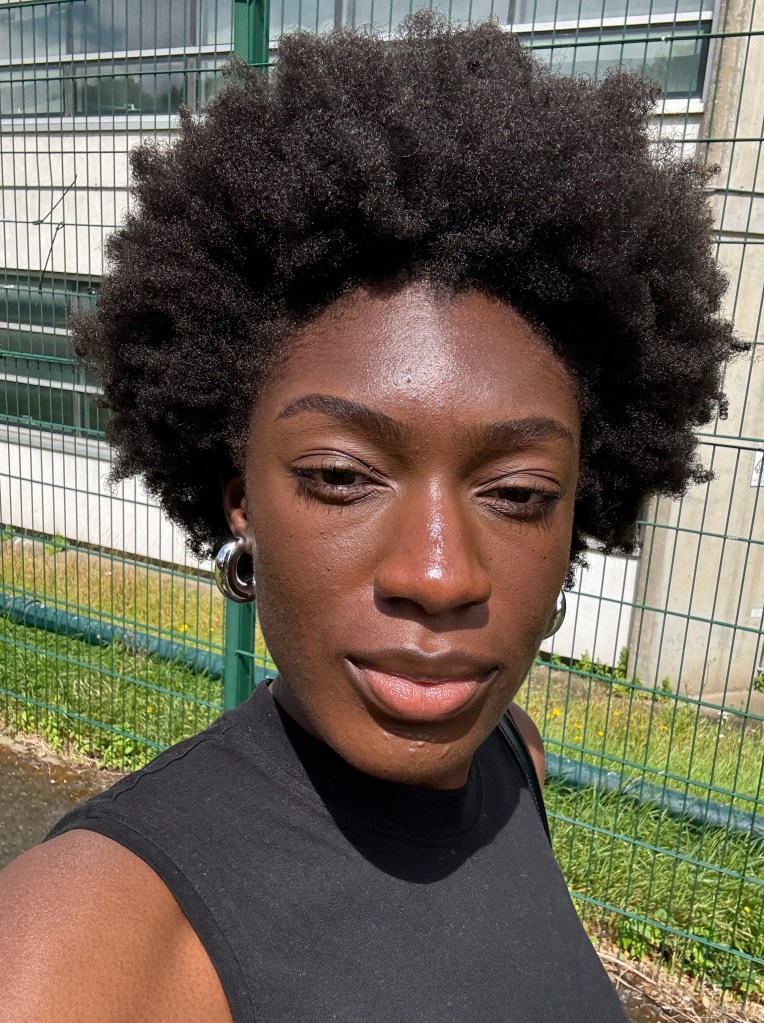
Much like the girls in my class or an auntie in church asking when I am going to do my hair, there are expectations of how Black women are allowed to be present in society. It’s a real shame to me that straight back cornrows are a foundation rather than the finished product. That an afro in its natural state out of the shower must be blow dried or braided to be styled and presentable the next day. (Pic from early 2024)
It particularly saddens me when we know these styles are also shunned by what we are taught are the preferences of Black men. That we feel childish with our hair in certain styles, or like we can’t get married or celebrate our birthdays in them. When did the disconnect return? This pseudo-avoidance of the natural state by virtue of relaxers, being a straight natural or undergoing keratin treatments truly washes away what it means to embrace our hair in its natural state, just for “ease”, to please others or feel self-confident.
I told myself a while ago that any man who doesn’t like my hair in its natural state should stay far away from me. Why should I want to be with someone that I can’t be free around? It’s better to be alone and teach myself to speak about my hair positively, experience exposure therapy by going outside with it “not done” and realise that I will make it home in one piece. Black women deserve partners that love and uplift them as they are. Whenever I see a Black woman with her hair out, in twists, cornrows or anything that requires low manipulation, I feel really happy and empowered. I can only hope that by doing the same I can empower other people.
I do not agree with regurgitating what society says about my hair as if it’s a belief I hold. Instead, I actively work against negative projections of afro hair because it’s just another way we are being kept in chains. The more of us that wear our hair out the better, whether you have a big forehead, or your hair is short, fine, very thick or extremely coily. The more we see each other like this, in all states, the better. It just needs to be normalised among us. The more you wait for your hair to be long enough to show the world, the longer you will hold yourself back from feeling liberated. I don’t care for conversations saying it’s not that deep to not wear your hair out. I am in the business of everything being “that deep.” (Pic from June 2024)
What suits you?
“My hair doesn’t suit me” is another statement I just can’t get behind. I believe that a different hair colour could work well with your skin tone and that different styles complement your face shape more than others. But your hair not suiting you is something I don’t understand. This may be why many of us spend a lot of time in other textures too – for the belief that something looser than what we have is more well-suited. But a certain type of dysmorphia occurs when we fail to see ourselves in our natural state every day. When our beauty ideals do not include natural hair and we only ever see being dressed up as when we are wearing looser textures or any form of extensions, etc, that is a problem, because we fail to recognise and accept ourselves.
What is more worth our time is investing in flipping that belief on its head by visiting a professional and getting a trim to start the hair journey from a good place. Investing in products that cater to your hair’s needs. Learning from others how to look after your hair. Taking baby steps towards being confident with it. It’s a journey. What I find captivating is the ability to see your hair on the same pedestal as any other style you have access to. It shouldn’t just be deemed a transition style covered with a bonnet on the way to the hairdresser. It should be the acceptable and embraced default. For the past two years I have been on a journey of wearing my natural hair out more than any other style – being that a textured half wig, slick back with yaki ponytail, braids or anything else, because the more I see my own hair the more I am used to it and the less I feel to change, cover or add to it.
My hair three years apart. During this time I built confidence with my mini twists.
Recommendations
One useful tip I’ve come across is embarking on the natural hair journey with a friend to build confidence together. Another way to change your thinking is to alter what you see on social media. I interact with natural hair content to let the algorithm know what I want to see, normalising afro hair in my online space and making it feel less alien to me. Once again, I am not against other hairstyles. I just think natural hair should be the centrepiece.
I’d like to end with some simple and affordable products for anyone hoping to expand their regimen or start a journey with their hair.
Nigerian Modernism is written in huge orange letters on a yellow wall at the exhibition’s entrance in the Tate Modern. It showcases the work produced by artists in the decades before and after Nigerian independence from British colonial rule. According to Curator of International Art Osei Bonsu, Nigerian Modernism shows off over 300 works from over 50 artists, and endeavours to inspire intergenerational conversations around Nigerian art, culture and music to name a few.
I felt at home moving through the various rooms in the exhibition, following a choreographed layout that the curators pulled of effortlessly. I looked into the past when witnessing the artists’ demonstrations of everyday Nigerian life, to battle, politics and mythology shown in their artwork. Below I explore the art that captivated me the most.
Justus D. Akeredolu – Thorn Carvings– 1930s
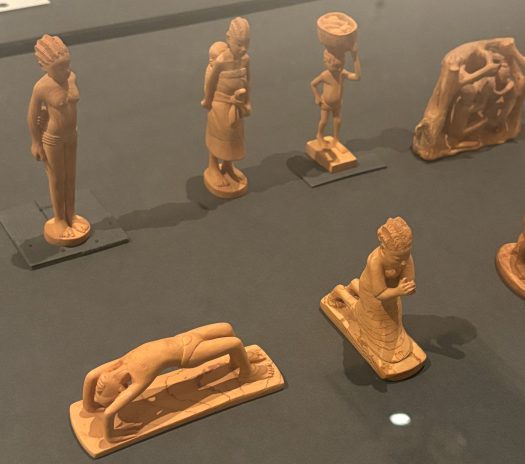
These were such a pleasure to look at. They depict moments and customs from everyday Nigerian life around the 1930s. Akeredolu first began creating these sculptures when carving the handles on name stamps (stamps you could use to print your name on a letter). He would use thorns of the silk cotton tree to do this. Eventually, he began using these thorns to make his Thorn Carvings. Akeredolu then taught this technique to his apprentices.
I like how fun and whimsical the carvings feel. The backbend one is my favourite. There’s a fun yet delicate nature to the pieces. Because of their size, they come across as collectibles.
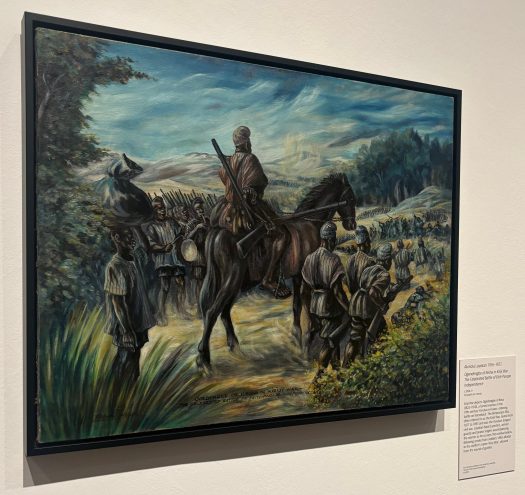
Akinola Lasekan – Ogendengbe of Ilesha in Kiriji War: The Celebrated Battle of Ekiti-Parapo Independence, c.1958–1959
In this painting, Akinola Lasekan depicts Yoruba chief and warrior Ogendengbe of Ilesha on horseback during Nigeria’s Kiriji War, also known as the Ekiti–Parapo War. He served as commander-in chief. The war, which took place between July 1877 and March 1893, mainly occurred to halt the attempted expansion of Ibadan city state.
There’s a majestic nature to Ogendengbe’s posture on horseback as he and fellow warriors look out to the landscape. Not often do I see depictions of 19th century Yoruba wars on canvas (believe it or not). This painting captivated me.
Akinola Lasekan – Yoruba Acrobatic Dance, 1963
When art captures a specific moment of motion it causes us, the viewers, to be captured as well. This was so beautifully executed by Lasekan here. The colours are to be expected in any artwork from such a vibrant people, so the juxtaposition between this and the expressive stillness is really gripping. To a degree you can hear the pin-drop silence of the painting as the dancer levitates. It made me want to press play to see him land and experience the motion of the crowd when he does. It’s just a cool piece of art!
This drawing, also by Lasekan, was part of a collection of political cartoons on display. I was most drawn to this one it because of the stone the imperialist was carrying, with “Macpherson Constitution” written across it. I did a bit of research. Established in 1951, the constitution divided Nigeria into three regions – Northern, Western and Eastern. It was Britain’s attempt to give the citizens more political say by virtue of legislature and councils in each region.
By producing these cartoons, Lasekan engaged in anti-colonial art activism. This is because their narratives spoke against the Macpherson Constitution and much more. The constitution was not the clear independence that people desired. Rather it was Britain’s way of upholding its imperialist presence in Nigeria.
This is something Tate’s exhibition does well – straddling the historical and the political elements of Nigerian Modernism, through the differing mediums of work explored by artists like Lasekan.
Ben Enwonwu – The Dancer (Agbogho Mmuo – Maiden Spirit Mask), 1962
This is a painting of a masquerade, most typically worn by men. The loose translation of Agbogho Mmuo is “Maiden spirit”. This masquerade honoured ancestors and unmarried young girls. Enwonwu drew inspiration for this painting and similar others from a book called Africa Dances by a British anthropologist named Geoffrey Gorer. The book critiques Britain’s colonial rule of West Africa.
Growing up, I only ever heard scary stories about masquerades, and I would probably still be scared if I saw one the next time I’m in Nigeria. However I can’t deny how beautiful they can be, as depicted by this very painting. The craftsmanship of masquerades alone is admirable. As a Christian it opens up questions for me, especially being raised to have distaste for anything to do with Nigerian/African spirituality. Yet, it feels like a waste of heritage to maintain an aversion to the history of my culture – being in the UK removes me enough. The masquerade’s posture and motion captured by the brushstrokes are what I enjoy about this piece. You can get a closeup of the painting here.
Ben Enwonwu – Seven Wooden Sculptures – 1960-61
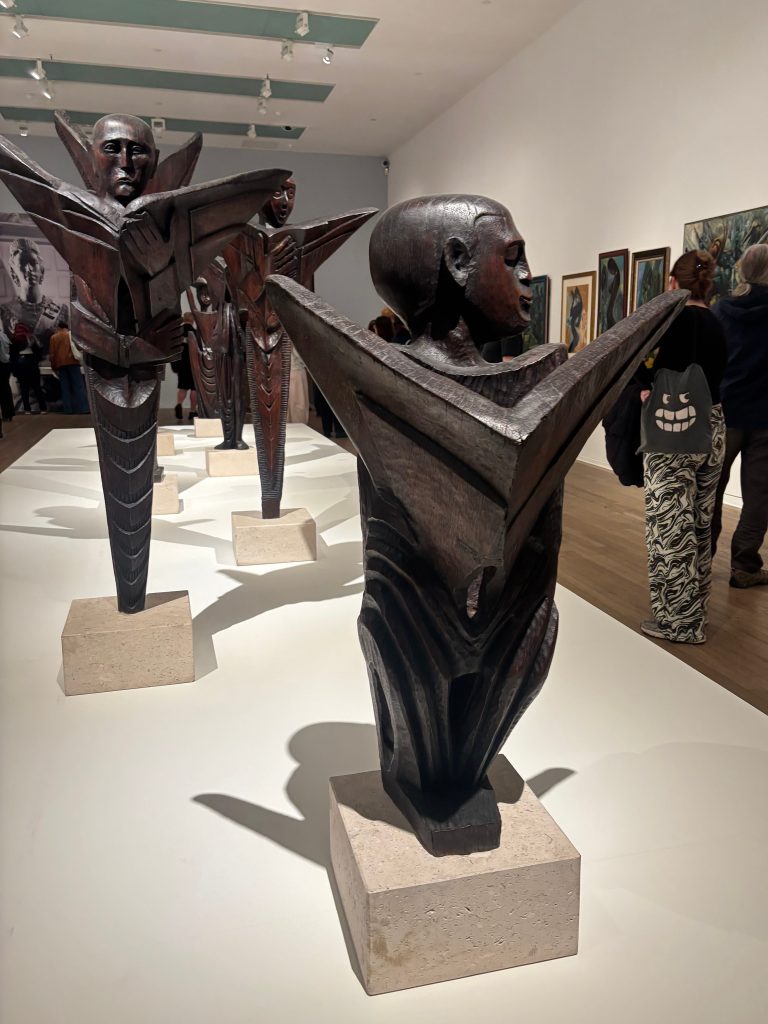
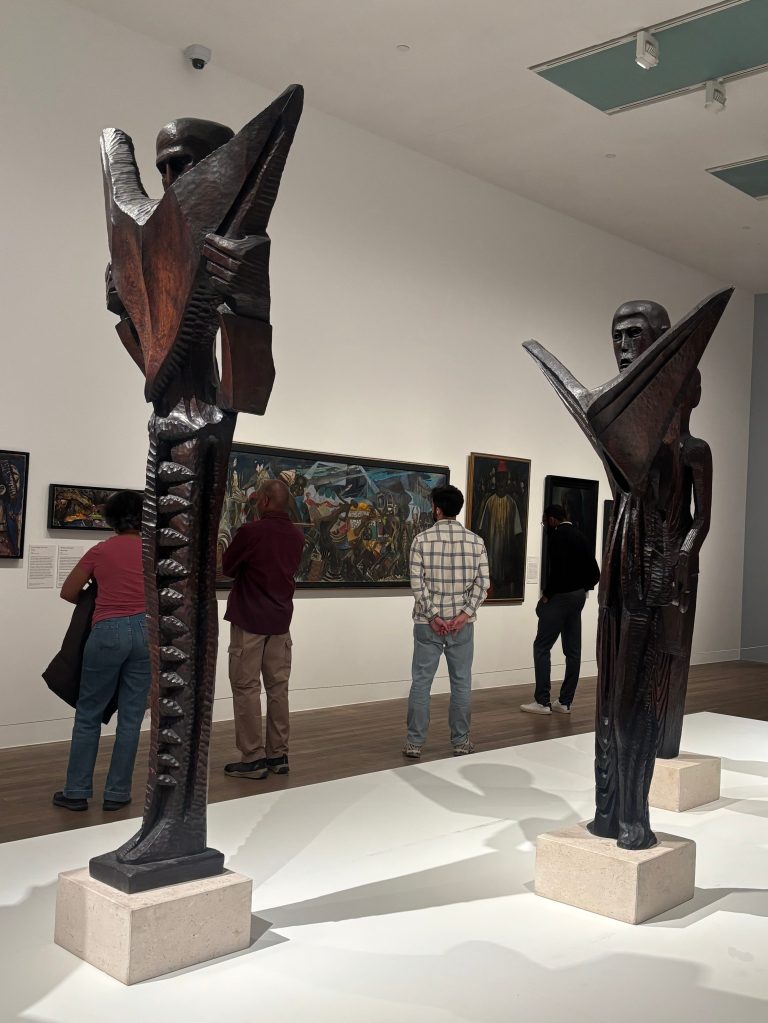
You can’t miss these wooden sculptures in the middle of the second room in the exhibition. It was a bit difficult to find out exactly what they were, but a bit of research taught me something. These seven sculptures were made by Ben Enwonwu for the Daily Mirror’s new headquarters that were opening in Holborn, 1961. Enwonwu had been commissioned by the paper following his growing popularity after producing a statue of Queen Elizabeth in 1957 and another well-known sculpture called Anyanwu in 1956.
I was so drawn to the expressions endowed upon the sculptures as they represented reactions to the Daily Mirror’s reports. As for the transformation of the newspapers into winged shapes, Enwonwu, said, “I have tried to represent the wings of the Daily Mirror, flying news all over the world… The group forms a sort of chorus. It is almost a religious group. All art, I believe, has a religious feeling – a belief in humanity.”
In 2013 the sculptures were sold for £360,000 at Bonhams after they were discovered in a garage at Bethnal Green Academy in East London. It’s unclear how/why they were removed from the Daily Mirror’s HQ.
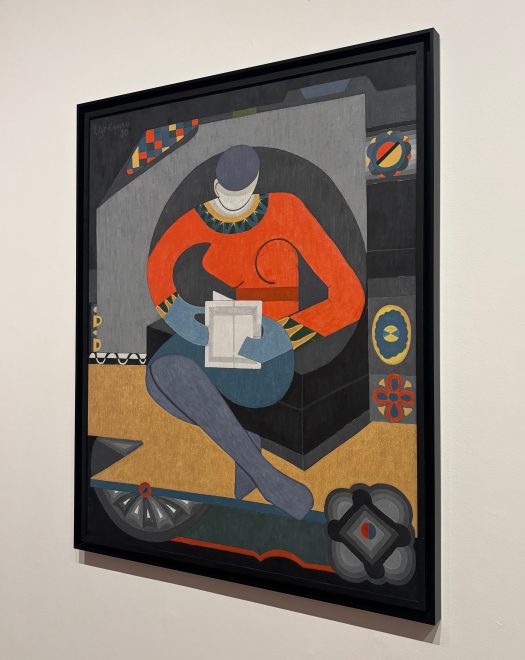
Ben Enwonwu – Untitled, 1960
Something about this painting reminded me of a popular painting by Annie Lee, called Blue Monday. She painted it in Chicago, 1985. The posture and blue hue of the top worn by the woman in Enwonwu’s painting is reminiscent of Lee’s piece . There’s not much information about Untitled in the exhibition and I couldn’t find much about it online. But there’s a pensive nature to the painting – a woman alone and deep in thought. I think anyone can see themself in this picture.
It was a refreshing piece to see among the other artworks with more outstanding narratives and acts of socio-political resistance. There of course remained moments pre- and post-independence where Nigerians paid great attention to their inner worlds just like anyone else. The world moves around us just as much as it moves within us. That’s what this piece represented to me in the space.
Ben Enwonwu – Fulani Girl, late 1940s
One of my aunties always calls me Fulani girl. According to her, I look like I am from that region of Nigeria. This physiognomic comment always felt like a nod to the interconnectedness of Nigerian tribes, despite the distinctive nature of them all. So the name of this beautiful sculpture, carved from a piece of ebony wood, drew me in when I first saw it.
Fulani girl was purchased by the Government Art Collection (GAC) in 1951. The collection displays works of art in British government buildings in the UK and around the world. Around the time it was sold, Enwonwu was passionate about his artwork being displayed in government spaces as he believed they would promote Nigerian art and culture. That’s a different tune to what we’re used to hearing around the collection of art from colonised countries. The bust itself looks so smooth and peaceful, and I’m led to wonder if it’s a depiction of a certain girl, or Fulani girls as one. According to GAC, the arch and general design of the sculpture is a fusion of Nigerian aesthetics and European art with aim to reimagine Nigeria itself.
Ladi Kwali – Ceramicartist
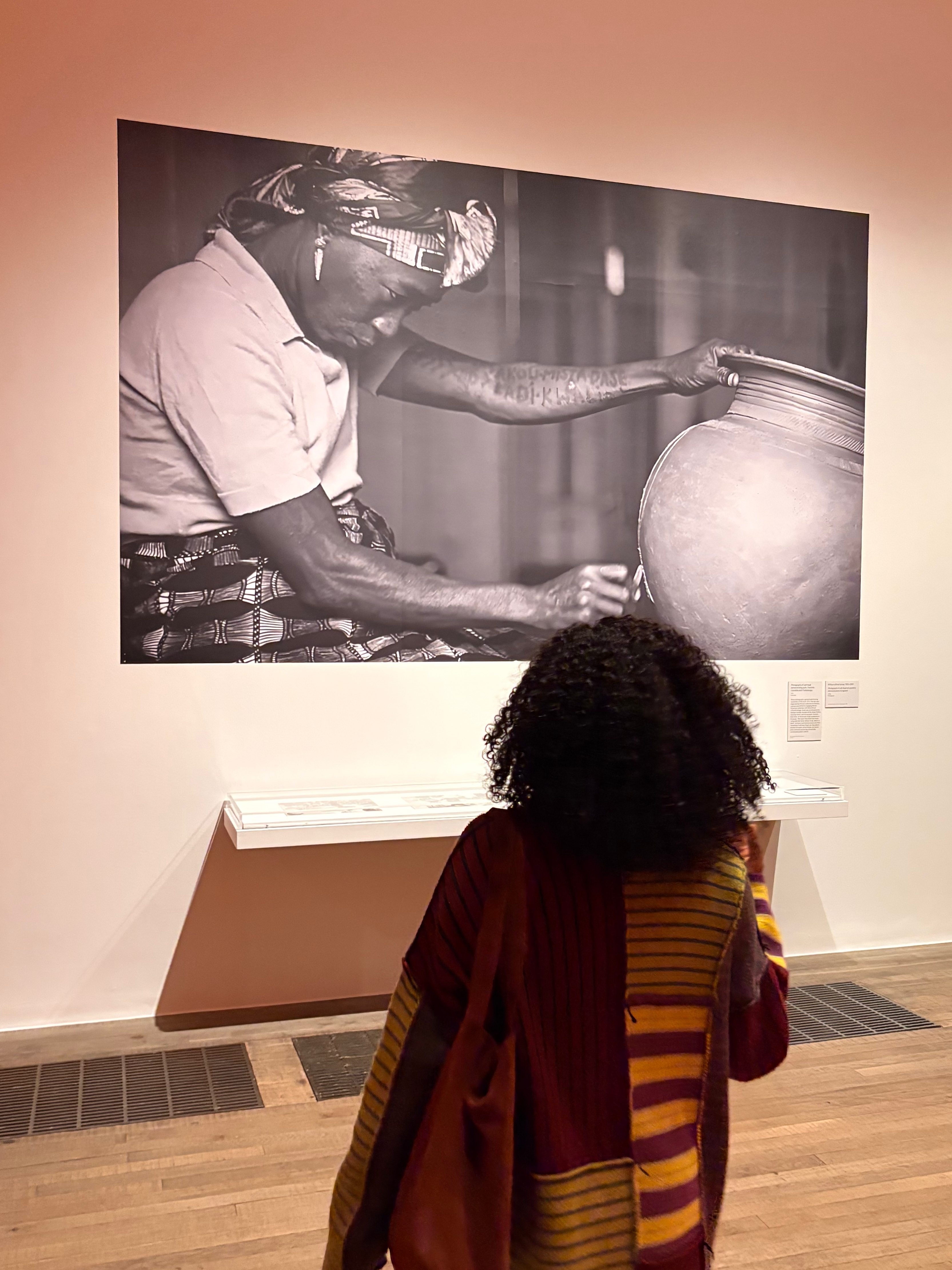
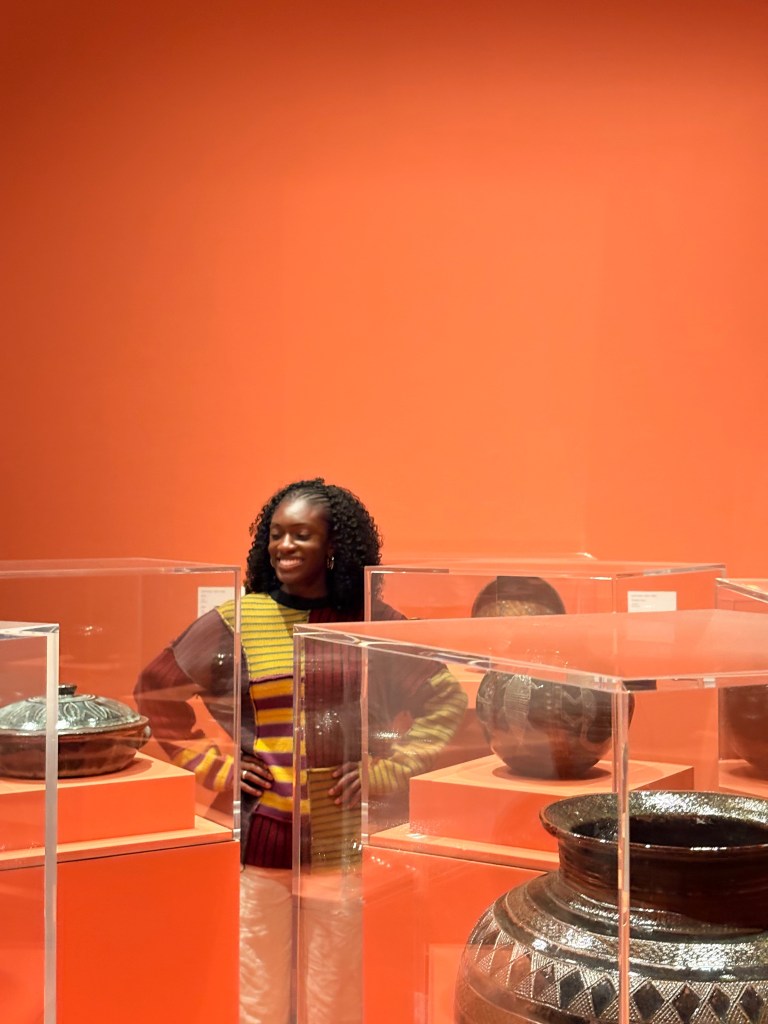
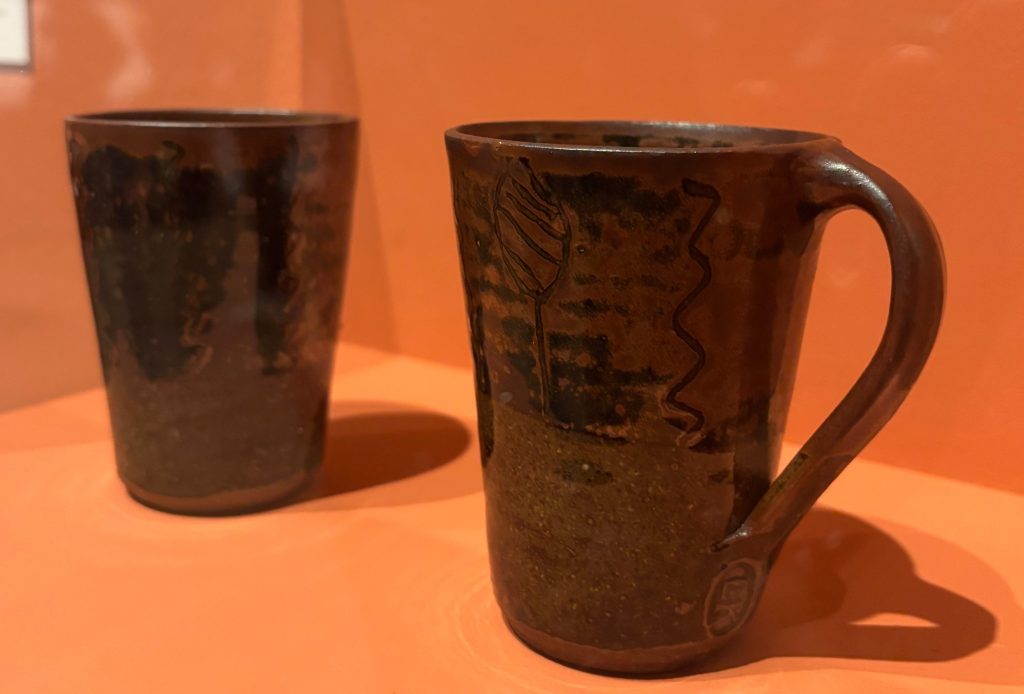
This entire room, painted the most beautiful shade of orange, was dedicated to potter and ceramicist, Ladi Kwali. Initially taught by her aunt, she specialised in traditional Gbagyi/Gwari pottery – the region she was from in central Nigeria. The room featured dishes, water pots, plates and cups/drinking vessels that Kwali made over her lifetime, charaterised by scoring, sgraffito and animal drawings against the dark glossy glazes.
This room emphasised Kwali as an artist, above a producer of domestic utility items. Her practise required immense technique and talent that deserves to be celebrated – and a room being dedicated to this celebrates that. Kwali went on to be the first woman to join the Pottery Training Centre in Abuja, 1954, and the only woman to be featured on Nigerian currency (the 20 Naira note).
You can see that I had the time of my life in this room. I feel excited when I see a Black person doing pottery on my fyp, talk less of a whole room dedicated to this greatness. I had never heard of Ladi Kwali before this exhibition, and now, or course, I will never forget!
Uzo Egonu – Poetess – 1980
This feels like a perfect artwork to end on. It was created closer to the end of the 20th century and Egonu lived in Britain while Nigeria was experiencing extreme corruption following the oil-induced economic boom of the 1970s. Parallel to this social change was Egonu’s loss of sight due to the harsh materials he worked with for his paintings – there was deterioration both within and around him. Tate called this room, “Uzo Egonu: Painting in darkness”.Poetess, the striking painting above, is part of a collection of artworks that Egonu named Stateless People. It was first exhibited in 1986 London and he stated, ‘My stateless people are far from being political or religious refugees. They are people who are symbolically stateless.‘
Poetess depicts a poet with presumably, her poetry. The others in the collection depict a musician, an artist and a writer. In all the paintings they are bent over their work. These people are symbolically ‘stateless’ because they are frustrated visionaries from a Nigeria that in Egonu’s eyes was yet to be commendable post-independence. It’s a critical perspective and Egonu was known for having such. He refused categorisation and was a radically independent artist.
***
Final thoughts
Painting in darkness was a balanced note to end the exhibition on, as often reflections on a nation post-independence can be quite sensational and lack nuance. It’s never a pleasant process to unpack the (lack of) progress a nation has made following centuries of trauma, however necessary to try. But even so, the beauty of art and culture produced by it are to remain celebrated.
In case you can’t tell, this is a very positive review of Nigerian Modernism at Tate Modern. I felt pictures are the best way for me to communicate why I enjoyed it, rather than an overall written piece with few visual references. I haven’t even scratched the surface of the vast number of artworks on display and the depth of information each room invites you to engage in from the entrance and throughout. There are rooms with films, highlife music, pamphlets, magazines, poetry, photography and more. So go and have a look! Hopefully this is enough of a taste of what you can expect in this well-curated exhibition.
THE BAD DAYS HAVE SUCH A POWER TO UPTURN PEACE THAT OUR TENDENCY TO PLAY IT SAFE BECOMES INSIGNIFICANT IN COMPARISON.
***
I may believe that changes in my mindset must reap results before I speak about them. But I won’t stall. Here are reflections on things I have started doing, which I believe will show positive results in my life.
Being audacious
I am not the most audacious person, but I am trying to be. Something that held me back from leaving my job was the fear that I wouldn’t be able to land on my feet. The fear that I would somehow wither away and nothing would become of me now that I left a good thing behind. What silently added itself to the equation was that also I didn’t feel brave enough to endeavour something new that would possibly reap disappointing rather than empowering results. There was nothing audacious about my mindset.
But I thank God that I took the leap anyway. Because that was an audacious choice. What’s more audacious now is my determination to go after anything that my heart desires, because why not?
And that is the question that audacity begs. Why not? Why can’t I imagine a beautiful life for myself after taking risks? Why can’t I assume that something good could come of this? Why can’t I be audacious in asking for help, making enquiries, professing positivity into my future, expecting good results?
When I spoke to a friend about what I’m hoping for since leaving, I caveated a lot of it with “but what if it goes wrong?”. All she did was challenge me with the question, “what if it goes right?”. And it put a fire in my belly. Whatever it is in my life that previously told me I have little right to think big or expect much from myself has got to shut its mouth! It’s interesting to me because I have only ever envisioned a great life for myself. But somewhere along the way I lost sight of how to get there and my fears crept in. So, rediscovering my audacity has become a step in the right direction, getting back onto the path that birthed me.
Throwing old clothes away
I’m going through a “clothing renaissance”. That’s what I’m calling it. For a while I have looked at my wardrobe and sighed! Nothing to wear. That wasn’t the case before, but the reality of ‘no clothes’ has crept up on me again. What is it about clothing that makes you wonder who you really are? Why do clothes have the power to bring down your mood so much? It’s presentation of course. Your clothes speak for you while your mouth is closed. So I guess the last thing I want is to visually/aesthetically come across in a way that is more congruent with who I was back when I bought something, than who I am now.
It seems there are different versions of us almost every day. Skin regenerates for a reason and I think our psyche is the same. So in reflection of renewal I ended up wanting to throw most of my clothes away. Too many t-shirts reminiscent of my early 20s that I don’t wear much anymore. Way too many plaid shirts, including the first one I thrifted when I was 17. I hadn’t worn it in over a year. It had to go. It all had to go. I tore many clothes off their hangers and dumped them into a charity collection bag because I felt too impatient to wait for someone to buy them on Vinted.
I can’t reduce this renaissance to my current self being incongruent with my clothing though. Beauce I think that implies I know who my current self is. And if we want to directly relate that to clothes, I must be truly lost because I don’t know how I want to dress right now anyway. Perhaps that’s truly it – I just don’t know who I am in this season of transition, or, “reinvention cycle” as articulated by a content creator I’ve been enjoying lately.
But I’m practising self-patience with it all because many things in life take time – the meaningful, deep things, especially. Greatness doesn’t happen overnight. Neither does talent, or pure genius. I think social media enables our forgetfulness when we see the finished product of people’s labour and fail to recognise that they laboured at all.
D’Angelo, a pioneering neo soul artist, passed away recently, aged 51. He had three albums to his name. The first was released in 1995 and the last in 2014. Since then, he had reportedly been working on his fourth. If you listen to his music, you will witness pure greatness. But the number of his albums within the time frame he released them reminds me that good things can take time. We don’t need to rush any process in this life. Time-sensitive ones aside I guess – but rushing should only happen if you are actually running out of time. And sometimes we move like we are when there’s really no clock ticking.
This opens my eyes when I consider the phase of life I am currently in. What is there to rush, really? Why should I let a loss of self-certainty make me feel so untethered? Even if my wardrobe is bringing me little joy, the last thing I want is to rush into whoever my next wardrobe will represent. Sometimes you just need to throw the clothes away and let it breathe. The development of you and I takes time, for this development is greatness in itself.
Illusions of control
I have desired the spirit of bravery for as long as I can remember. Yet, I am pretty risk averse. However, since summer I realised I don’t have an excuse to not take risks. This ties into being audacious. One major thing that may stop us from being brave is fearing an unfavourable outcome — fair enough, it’s human nature. But when I think further, I realise that not only is it fear, but it is also control. If timidity holds me back, I can at least save myself the heartbreak of failure and stay in my comfortable place. We don’t say that word-for-word so I am saying the quiet part out loud.
My epiphany came when I realised that this control we [subconsciously] grip onto is an illusion anyway. Because you can do everything right in life: play it safe, make calculated decisions, take a leap only when things feel right… and tomorrow could still end up being the worst day of your life. You can’t plan that. So, what were you controlling really? I guess the average day-to-day is under our surveillance to great avail. But the bad days have such a power to upturn peace that our tendency to play it safe becomes insignificant in comparison.
So I have been asking myself, why not just be brave anyway?Why not accept that it’s only a force bigger than myself that could ever be in true control of my life? How much freer will that make me feel? How many opportunities for the expansion of my joy am I missing out on because I keep playing everything so safe?
They say when you know better, do better. And I feel like this realisation is endeavouring to better me. So I need to act like I know that, and keep being brave.
The freedom of pointlessness
If you are hoping to read the Bible more, or tend to have a pessimistic outlook on life, I would recommend reading Ecclesiastes. It rocked my world when I read its first two verses as a teenager: “These are the words of the Philosopher, David’s son, who was king in Jerusalem. It is useless, useless, said the Philosopher. Life is useless, all useless.” That philosopher told no lies. I felt very seen when I first read that book. It truly does capture the essence of life – the pointlessness of it all, since we will die one day. And this truth being put into these words opened my eyes to a way that I can operate in my life: pointlessly. I think that sounds kind of crazy, but it’s not that crazy when you think about it.
In a recent conversation surrounding someone’s grief, they told me that rehashing the pain by speaking about their grief and how they are feeling, followed by sadness, tears, and the heaviness of it all, then moving on and repeating that cycle when the feelings get heavy again, makes them wonder the point of speaking about it in the first place. My only response was to ask whether there had to be a point at all.
Life is pointless anyway right? So why don’t we just keep doing pointless things while we’re here? We speak so highly of purpose and ambition but I think we’ll be damned if along the journeys that they push us through, we fail to acknowledge the eventual pointlessness of it all once we pass away. Of course there are legacies and immediate results of many endeavours, but the greater personal pursuits of life can often feel like there’s no point to them, especially during moments of disappointment. So I begin to wonder if that’s something we should turn towards and embrace rather than treat like the greatest inconvenience of all.
Do we remember how much peace can be found in surrender over resistance in the right places? If I accept that the things I do may have no point, it could really reduce my attachment to outcomes, no matter the size of the endeavour. I don’t think an assumption that I won’t have motivation for anything as a result even applies here. I think I can acknowledge that there’s probably ‘no point’ of something but do it anyway. That can help me really, really experience life as a human in this pointless world!
I can make friends with one of life’s most demotivating elements. I could even take it so far as to do pointless things on purpose if I really wanted to. Surrendering to the pointlessness of life and choosing to live anyway is what you will find me doing going forward.
*
And that is it. I hope these reflections resonated with you. I am always grateful for realisations that make me feel a bit more free; freedom being a constant desire of mine. And thank you for taking time to read this all.
I AM GOING TO FIGURE OUT HOW TO LET MY DAYS BREATHE
I try to be private so I see many thoughts as ones that belong to my diary. To be honest it’s probably more that I feel like they aren’t worth sharing because you’re likely to have come to these conclusions yourself. But perhaps I should share them anyway. So today we begin with one. It’s about not rushing in life.
Leaving so soon girl?
There always seems to be a reason why I can’t stay somewhere for too long. Or why I can’t do something for too long. I can’t watch a movie in one sitting because I have things on my to-do list that I need to get done. I can’t stay at this event too long, at least without feeling on edge, because I live far from here and I don’t want to get home too late.
It was easier for me to be in a justified rush like this when I had a job. But now, I don’t. I have nowhere to rush to and on most days, no one waiting for me. So, for the first time in a while there’s little reason why I cannot wake up when my body wants to, watch a whole movie in one sitting or talk to someone for hours on end with no need to rush the end of the conversation.
But knowing this doesn’t mean I am putting it into practice. As I write, it’s Friday. I am sitting on my yoga mat in the garden, and the sun is out. I just did my 6-minute stretching routine and there’s no rush for anything today, really. I’m just meeting some people later. Why not just just take my time today?
Any solutions?
I am going to figure out how to let my days breathe. Take my time making my breakfast, sit down and chill when I feel a sudden urge to. Attention-span wise I know I can start by at least consuming more long form media because I’m not in a rush to get my serotonin up. I just need to take my time.
It’s a tough trait for me to learn but I know I will be better off for it. The same applies to figuring out what I want to do next in my life. If I could rush into it I would, to ensure financial stability as soon as I can – that’s my only worry now. So, I figured that if I find a way to rid of that anxiety and trust that this moment is just part of my journey, I can embrace this period of my life in a very beautiful way.
IN THE MOMENT IT FELT LIKE A SUDDEN EVENT, BUT UPON BRIEF REFLECTION I REALISED IT HAD BEEN AN EVENT IN THE MAKING. MANY DROPS FILL A CUP UNTIL IT FINALLY OVERFLOWS.
***
April 2025. The beginning of the end
I begin this piece at my desk in our London office. I’d like to call it my old desk actually, because by the time this is published, I hope for this chapter of my life to be closed.
Today I produced a video about the effect of Donald Trump’s tariffs on the EU (latest here). That’s what I did day to day as a video journalist – produce news videos and keep audiences engaged throughout them. Now, is audience engagement something I have always been passionate about? Definitely not! The only audience engagement I’ve ever been interested in is that of this blog. So that aside, no, I don’t care about audience engagement. And that’s one epiphany that led me to leaving my job.
Overall I realised there was a lot at my place of work that I no longer cared about. I didn’t care much about the company’s vision, the performance of its content, or the trickle-down effect that improving our production will have on our audience. I did, however, care enough to keep me afloat there, probably for longer than was beneficial to me. Enough to help me survive rather than thrive. Caring about my work therefore became a personal principle over time – I’m not the kind of person that can clock in and out, not valuing what I’m doing in-between.
How did I get here?
I passed my journalism diploma in 2021 and got into the industry through an internship that began two days after Russia invaded Ukraine (latest here). I was inundated with more information than I could understand, so it became my mission to comprehend all this new information. From random acronyms I couldn’t guess the reasoning behind to editorial decisions, the industry felt like a brand-new problem to solve – a puzzle to complete, something to learn and grow within.
And this was my mission for the three years I was there – first as a digital video intern, then full time staff as a digital video producer. Throughout I was determined to understand the inner workings of this huge network while just being a “good enough” journalist pitching stories from hard-hitting and breaking, to light-hearted and feel-good. I reported on so many stories in those three years that I can’t list them all.
Then Israel’s war on Gaza began (latest here). And this moment in time – this genocide, aside from teaching me a lot, triggered a chain of events.
Burnout knocked on my door
I was burnt out. I did a lot of overtime and the stories were taking a toll on my mental health. We were reminded to think of death tolls as people rather than numbers, but I knew this would grow more difficult as I became desensitised by the volume of saddening stories I learnt about. Even the mental health resources available to me didn’t seem enough to process the tragedies I reported on so regularly.
And when I got my hours back for overtime, the damage felt like it had already been done. My brain would spend so much time cooling down from an intense shift that the less intense ones felt like an oasis in a desert that I couldn’t even appreciate. Like an overheated computer, my body would feel uncomfortable, my head hot, chest tight, and my eyes so tired from looking at multiple screens during my edits. There were days I walked out of the office building feeling like a zombie, crossing the road with eyes that could look but not see, falling asleep on the train, sweaty and exhausted, knowing I would do it all over again tomorrow.
So much of my time outside of work was spent recovering from work and my creative endeavours took a back seat. So, in the last few months that I spent there, despite feeling the most confident I ever had been in my role, it felt like my day-to-day at work was cannibalising what I hardly had left of myself.
Second-hand PTSD
It came to a head in the early hours of a Saturday morning in February. My parents came home late and accidentally slammed their bedroom door, which is beside mine. It woke me up, violently. The first thought that came to my mind was “airstrike.”Airstrike! Never in my life had a loud sound triggered something so specifically violent in my head. The gravity of the situation hit me when people reacted to this story. And when I spoke to my therapist about it months later, she gave the moment a name: Second-hand trauma, second-hand PTSD.
I wasn’t even the person filming the airstrikes that I watched while searching for impactful news videos. I’d never been in a house when an airstrike made impact. I was in fact a video journalist sitting in front of a screen in London, watching violent attacks on innocent people.
And after three years of such violence consistently passing my sight, I woke up with a beating heart at the sound of a door slamming, reminiscent of something that had ended the lives of countless numbers of people across the world.
Something similar happened a month later early in the morning, in between asleep and awake, and I thought again – airstrike. What more of a reason did I need to consider how my job was impacting me? I knew my mental health was crying out for help. The light-hearted stories I did every now and then could not drown out this noise.
I’d like to be perceived within context as I write this. I’m not the only journalist in the world that is affected by the stories I’ve covered. As I mentioned earlier, I’m not the person whose house was struck, nor the person that filmed it. It wasn’t my job to blur videos of dead bodies either (even though I have had to blur other things). My coworkers were also affected by the nature of our work – I know. The correspondents and field producers who were flown to war zones within hours of them breaking out were too, along with the news anchors having to remain composed while reading out heartbreaking lines. All of it.
At timesI would move through the office and look at people, wondering who else’s heart felt as heavy as mine. When I spoke to others in my last days at the job, everyone resonated with what I was saying. It is a very intense job, and the exposure to violence and traumatic content is rife. But some people have coping mechanisms to help them stay, and some simply don’t.
May 2025. Work-related stress
So, a month after I began this piece the doctor wrote me a sick note. The irony was that I’d just returned from a two-week holiday in a neutral enough state to feel optimistic about things getting better at work. Yet a week and a half after my return, I was signed off due to work-related stress. I’d known it was bad when I took a break from my overtime to speak to the doctor about feeling burnt out then returned to my desk afterwards to finish said work. I had to get it done!
In the moment the sick note felt like a sudden event. But upon brief reflection I realised it had been an event in the making. Many drops fill a cup until it finally overflows.
I took two weeks off work to try and recover from the stress. Two weeks became four, and four became six. Six weeks. I spent my days going to the gym, thinking about what burnout meant – “is it a genuine thing?” Telling people what I was up to and slowly coming to terms with the uncertainty of my near future. When I returned to work in June, I still didn’t feel like I’d had all the time I needed to recover. But I did know that that time off lifted a weight off my chest and I began to feel happier. So when I chose to return to work I told myself, the sooner I return, the sooner I can finally hand in my notice and leave.
What a process it had been, because I’d honestly known since January that I needed to leave my job (I was fasting and praying about it). But coming to this choice was a slow process. I didn’t plan to be signed off but I see it as the destined denouement of my journey. I wanted to leave by July 16th, my 26th birthday – or simply by the end of summer.
I’m gone!
I walked into work on the day I handed in my notice not knowing that I was going to do it. I entered a meeting room with my manager that morning wondering what I would say to her, and how honest I was going to be about the feelings pulling me away from my role. Maybe I’ll tell her in a couple weeks – maybe in a month? I don’t know, as long as I leave by the end of summer…
She asked me how I was doing and later, what I was “thinking.” Suddenly truth was my only answer. I could have said I’m ready to get back into the swing of things and I’m excited for my future at this network, but instead I found myself saying it’s time for me to go. The words left my mouth because I let them. In that moment, I let go of stability, a solid income, part of my identity, and elements of myself. And the rest of the day was chained to relief, anxiety, sadness and eventually numbness. I can’t believe I just quit my job, I thought to myself. It was a big deal to me. I always thought such a decision would be more premeditated than this.
I thought I’d return to work with a new job offer in my inbox, making it easy to let go of this one. But what had become more important to me was knowing that I need to “move” in my life. I haven’t been able to shake the word for months. I need to move. So, there I was, and here I am, moving.
Beyond that, I am putting myself and my mental health first. That’s something people have been commending me for – from my friends to my former colleagues. Well done for putting yourself first. What they may not realise is that I learnt to do that just now. I have not been a person that puts themself or their mental wellbeing first, but this period of my life has taught me how to do it. I can’t turn back now.
What does this feel like?
I could go on for ages about the incremental epiphanies I had in approach to my final decision but they are probably more relevant to my diary. But one that I will share follows a question my therapist asked me a day after I handed in my resignation: What did you learn?She suggested that the rollercoaster of relief to numbness was reflective of the grieving process, and that since my day of resignation I have been grieving my job. I still find that hard to accept. She then mentioned another stage of grief, which was purpose, or lessons learned. Reflection. What am I now that I have lost this thing?What has the experience taught me, if anything?
I answered, “I have to make some decisions in the absence of confidence” (less elegantly than that). I must go forward in life knowing that my decisions won’t always be made confidently! That’s when my heart comes in. In my heart, I knew it was time to go. Some people advised me to wait until I got another job before I left but that did not align with how I felt. Such advice filled me with doubt until the second before I said I want to resign. Because in that exact moment, the only person I was thinking of was myself. My decision, although lacking in confidence due to the uncertainty of life following it, was made for me, by me.
And the cherry on top is that my last day is the day before my birthday. That feels like a confirmation that I made the right choice, because it is something I previously expressed that I wanted. So divinely aligned, maybe I spoke it into existence. Maybe it was God’s plan all along.
What now?
I don’t hate journalism. I actually really like it. I had the opportunity to learn something new about the world every single day. And maybe breaking news just isn’t the home for me. Something else in the industry could eventually be and that gives me some peace.
Now I am on a break from work. Don’t be fooled, I have applied for other roles! But the job market is just as bad as they say (when don’t they say that?) and to be honest, I’m not sure what I want to do next anyway. I don’t know if I’ll try a new industry, take a course, or boomerang back to journalism.
But what I do know is that I’ve taken a step in the right direction. Plus, I live at home, I’m not married and I have no children – I have minimal responsibilities. So, if now is not the time to explore, when is? I want to use this time to reconnect with my creativity and walk down the street with nowhere to really be. Of course, money will be tight but that’s life, inconsistent. There will be a time when money is abundant again and I look forward to it.
Life is fluid. Everyone’s path is so different and there is no right way to do things. I realised that during this journey too, as I would voice my thoughts in the hope that someone would validate or correct them in case my moves were wrong.
But no answer besides my own was the right one. We write our stories as we live them, and it is so clear to me that a new chapter in mine has just begun.
I woke up on a Sunday in March with no plans aside from a concert in the evening. It was so sunny outside, and it brought feelings of hope to me. Being March, the sun felt like nothing but a representation of Fool’s Spring. But nonetheless, I can’t deny the feeling that sunshine in the morning brings. Sometimes the sun is so present that you may be tricked into thinking it’s actually warm outside this time of year.
I always found it interesting that we can feel the sun’s warmth all the way down here. It really is scorching hot. It’s just the air that’s cold. I’m no weather girl but from what I know, its the air that really tells us when winter is dead, that even when you’re standing in the shade, sweat can be dripping down your back.
I felt a lot of hope. Amid the millions of thoughts flying around my head in recent months, things felt a bit clearer and hopeful.
My problem is that it often takes sunshine to feel that. For me, aside from the wildcard days when I remember my life isn’t all that bad, sunshine is what it may take to lighten my mood. That is ironically married to the fact that I live in England, where there is sun for what feels like 20% of the year.
The recent burst of sunny days we have had stir up strange feelings within me. Like a child who has been deprived of something they wanted for so long, I struggle to take in these rays, even though I know they lift my mood. Sometimes it’s Fool’s Spring after all, and within days the clouds come back to play. It must be that I know this sunshine won’t last forever, so why embrace it at all?
That aside, the feeling of hope that graced me on that Sunday morning is something I want to feel more during winter. Instead of seasonal depression and the desire to stay inside with dreams on hold, I want to look into the darkness in December and still feel hope. I don’t want to inadvertently rely on one element to determine how I will feel at the top of my day.
How do we inject hope into winter? How do we treat darkness as if it’s light?
I know some people may say the dark winter is to be embraced. So what if you don’t feel hope specifically – what if you feel something else that is also good for you? Whatever that may be, I’m not too sure of it as I write this. Perhaps it’s determination, planning, hard work, or something like that. People use the winter months to lock in and plan for the year ahead. And I guess if you’re still on track with your New Year’s desires, this weather can give you the boost you need to continue.
What I’m getting at is a consistency in emotion. But rather than answers, I’m left with questions within my power that I feel encouraged to explore:
How can I cultivate a rhythm of hope regardless of the season?
Can I find beauty and light in the darkness?
Can I embrace Fool’s Spring even if it only lasts a few days?
Can I show grace to myself this coming winter if hope still eludes me?
Weather is so impactful on my mood. My birthday is in the middle of summer, and I take it personally when it rains on that special day. In the lead-up, I obsessively check the weather for July 16 to see what I can expect, essentially knowing my mood will be dictated by it. Perhaps it is not something I can change about myself, but I think it would be nice to have an approach to life that is so consistent, that the weather doesn’t faze me at all.
Maybe I am just human though. We go through seasonal changes for a reason (play Seasons Change by Corinne Bailey Rae). So how then, if anything, can I embrace it all?
I’M VERY SURE THAT I CAN USE RESISTANCE AS AN INDICATION OF WHERE I SHOULD PERSEVERE.
***
I haven’t written much poetry this year. I’ve known this all along. But that didn’t lift my fingers to type anything. They remained where they are. Still during a nap. Scrolling, holding someone’s hand. Doing my hair. Not writing.
If I don’t get anywhere soon with my poetry, that’s okay. I’m not in total control of my journey. God is. All I can do is apply myself and be kind to myself. This journey of life isn’t about proving who I am to any being – myself included. I want to prefer journeying the path and seeing myself slowly get there. I will get somewhere eventually. I can take the scenic route perhaps.
RESISTANCE
I believe that the dreams recurring in my mind and the places I long to see, are the places that should see me.
Because of this, I observe resistance on the path towards where I want to be. I’m yet to figure out why it lies there. But I’m very sure that I can use resistance as an indication – a signpost of where I should persevere.
I have experienced a lot of resistance towards poetry this year from what feels like myself and external forces. A lack of self-belief and organisation/motivation has held me back from submitting poems to journals, which is the first step towards being published by an actual publisher.
On the flip side when I have tried, I’ve received way more rejections than acceptations. But I won’t lose sight of the one acceptation I’ve had. I eventually set my heart on having just one poem published this year, and I’m getting that this month!
Yet, I do still fear that I am fizzling out. Even though it will take a lot for me to get to that point. But I also believe that my path may just be slow– having a love for something like poetry doesn’t have to manifest through “achievement.”
As someone with a meritocratic mindset it’s hard to not link achievements to self-worth. But I think a slow journey might be good for me (but bear in mind that if it was fast I wouldn’t mind either lol).
If by the end of my time I have maintained an undying dedication and posture towards poetry, it will be a life well-lived.
I think I can pay more attention to the things in life that take time and let the heavy feelings pass through me. I just tell myself they’re going to go away eventually because they usually do.
And finally, I’d like to leave you with questions I am asking myself: What direction is my resistance coming from? Am I resisting the dream or is there an obstacle in my path, resisting my progress? Is it both?Will I persevere anyway?
Maybe it’s relevant that I turned 25 last week. Maybe it’s a turning point. I hope it is for my blog specifically.
Yesterday I spoke to someone I don’t see very often. He asked how I’ve been and I sighed – don’t we all. We either say I’m here, life is lifeing, I’m good…
I went home wondering if it’s best to be more specific. How was your journey here? I like your top! You look happy (even if you don’t). Something! I get tired of the same old conversation, how are you… And I ask it myself because we want to know how each other are doing. I think there’s a sharper entry point to conversation though. Or else we’ll just start talking about work.
WHO AM I?
I’ve been in touch with existentialism for as long as I can remember. Like when I was younger and would have moments where I’d repeatedly ask myself who I am until I lost a total grip on reality. Sometimes I still do that to see if I’ve still got it.
A couple months ago I decided to stop speaking and journaling about how directionless I feel in life. All I have been able to see are roadblocks in front of every possibility. To be honest most of those blocks are myself and my apparent inability to get up and do what’s best for me. So I stopped addressing it because self deprecation isn’t fun to express nor hear.
I have been enjoying Mariella by Khruangbin ft. Leon Bridges. Oh what a beautiful song, I’m writing to it right now. I don’t believe in past lives but if I did I would have heard this one in it. Serenity, nostalgia, heartbreak, longing and yearning for something out of reach. Incapable of finding all the words. That’s what the song sounds like. So beautiful. Elements of my life feel like that song.
My blog hasn’t been the same since this post in 2021: Peace in my mess. (Untangling the earphones of life). Nobody was asking me to figure life out on this platform but I truly lost any semblance of an ability to continue doing that – I don’t really have much to say anymore.
But perhaps there’s value in returning every year to reiterate that. Lol maybe.
IS THIS MINE?THIS IS MINE.
It’s July 2024. A year ago I was settling into my job. A few months prior, I didn’t have one. But now, I have a job, a car, and healthy relationship. I’d been struggling to own any of that. In those three areas I’ve felt like I am playing house. Like I’m just pretending the car, relationship and career belong to me and deep down they will all go one day and the real me that doesn’t have much will resurface. Maybe that’s easier to accept than life bringing to reality the things that have been waiting for me to arrive.
But, unexpectedly, after my 25th birthday, I suddenly accepted that this is mine and I can get on with it. I can be the adult I’ve been in denial of technically being for the past few years. I know we all struggle to believe we’re the new adults but perhaps we don’t need to ‘believe’ it if we just know it’s the fact.
MY CAREER
I have been in journalism for about three years now, as a student to a freelancer to a full-time employee. I chose the career because I wanted to learn about the world and feel smart. And I have the writing and video editing skills to do it. But what I really want to be is an author. I want to write a novel! I want to look out of the window and experience life and let my work flow from it. These are some things I’m figuring out with my new therapist. I like her.
It’s something I’m gradually accepting. It’s just been a bit difficult for me because I chose stability after university and I am worried about adapting my lifestyle to something that’s more precarious with a lower income (for now!) I even told myself it’s better to be a video journalist because if I was a normal journalist I’d lose my love for writing. But I haven’t even tried that out to be so sure of it. I produce videos almost every day at work and I don’t get tired of using the software after hours for my own passions. Who’s to say writing can’t be the same?
I DON’T KNOW
Oh I don’t know. It would be interesting to see my blog transform into a collection of things I don’t know. I must tell myself that doesn’t mean I have nothing to say. What I have to say, is that I don’t know. There is no benchmark telling me that’s not good enough.
I think there’s enough advice flying around anyway.
MY SELF-TRUST
An epiphany I’ve had recently though, is how much my overthinking is linked to a lack of self-trust. When it comes to decision making I’ve learnt that it’s best to just pick something and stick to it. If it turns out great then amazing! If not, I must trust myself enough to get out of a sticky situation.
For me, self-trust is the ability to make a choice and know you’re capable of dealing with the outcome. Do I see myself as capable? Do you see yourself as such?
Can the practice of swift decision-making develop your self-trust in the long run? Can you just pick something when overthinking rises and navigate the results? I hope I can. I will in time.
SO…
I told people that I’d leave journalism if I had somewhere else to go. Nothing really piques my interest like novel writing. And art, I’d like to be an artist. One of my aunties visited last week and saw a couple pictures I painted at sip and paints. She noticed my initials on them and was really impressed. “Me?!” I said, when she told me this. Disbelief – lol I am so bad at art. She said no. The paintings are nice. And I must say, i’m getting better at pottery too. God, is that you? Could I be an artist?
Could I be anything? They told me this 20 years ago, but is is still true, that I can do anything I put my mind to?





 Some Variables